

A custody contract — more commonly called a custody agreement — is a written document that spells out how two parents will share legal and physical custody of their child after separation or divorce. It covers parenting time, decision-making, holidays, expenses, and what happens when something goes wrong. Once a judge signs it, it becomes a court order both parents must follow.
This guide gives you the full template, walks you through every clause, and shows you what most people get wrong the first time they draft one. Use it as a starting point, then have a family law attorney review the final version before filing.
What Is a Custody Agreement? (And What It Isn't)
A custody agreement is a written, signed document between two parents that defines:
- Who has legal custody — the authority to make major decisions about the child's education, healthcare, and religion
- Who has physical custody — where the child lives and on which days
- How the parents will communicate, share expenses, and resolve disputes
It is not the same as a divorce decree, a child support order, or a verbal understanding between parents. A custody agreement is a standalone document. It becomes enforceable when a court reviews and approves it — at that point, breaking the agreement is the same as violating a court order.
Most states allow parents to draft their own agreement and submit it for court approval. That path saves money compared to a contested custody case, and it tends to produce arrangements parents actually follow — because they wrote the terms themselves.
Custody Agreement vs. Parenting Plan: What's Actually Different
These two terms get used interchangeably, but they mean slightly different things depending on the state.
| Document | What it covers | When it's used |
|---|---|---|
| Custody agreement | The legal framework: who has custody, decision-making authority, the basic schedule | Required by the court, becomes part of the divorce or custody order |
| Parenting plan | The operational detail: daily routines, communication rules, transportation, holiday rotation, exchanges | Often attached to or incorporated within the custody agreement |
In about half of US states, the court uses one combined document. In the other half, the parenting plan is a separate attachment. Either way, both topics need to be addressed in writing. If your state's court uses different terminology, follow the form names on your local family court self-help portal.
Is a DIY Custody Agreement Legally Binding?
A custody agreement signed only by the two parents is a private contract. It is not enforceable as a court order until a judge reviews and approves it — a step usually called incorporation or adoption.
The path looks like this:
- Both parents agree on terms and sign the document
- The signed agreement is filed with the family court that has jurisdiction over the child
- A judge reviews the agreement for completeness and for the child's best interests
- The judge signs an order incorporating the agreement
- From that moment, the terms are enforceable through the court — contempt, modification petitions, and the rest
In most uncontested cases, this process takes 30 to 90 days and does not require a hearing. In some states, mediation or a parenting class is required before the judge will sign. Check your local family court rules before you file.

What Every Custody Agreement Must Include
A custody agreement that survives court review and real life has ten core sections. Skip one and you create a gap that becomes a fight later.
1. Legal Custody and Decision-Making
Legal custody is the authority to make major decisions for your child. Most courts default to joint legal custody, meaning both parents share the decision-making.
Spell out:
- Whether legal custody is joint or sole
- The four major decision categories: education, healthcare, religion, and extracurricular activities
- How tie-breaking works if you disagree (often: mediation first, then a tie-breaker parent on specific topics)
- A rule for emergencies: either parent can authorize emergency medical care and must notify the other within a defined window (24 hours is common)
2. Physical Custody and the Parenting Time Schedule
Physical custody describes where the child sleeps and on which nights. This is the section parents argue about most because it determines daily life.
Cover the regular weekly schedule first. The most common options:
- 2-2-3 — alternating two-day, two-day, three-day blocks (50/50)
- 2-2-5-5 — two days with each parent, then five days with each (50/50)
- Week on / week off — full weeks with each parent (50/50, older kids)
- Every other weekend + one weeknight — traditional primary/secondary (roughly 80/20)
- Custom hybrid — designed around work shifts or school location
Whatever schedule you pick, write it down with specific days, specific hours, and specific exchange locations. "Friday after school" is too vague. "Friday at 5:00 PM at the child's school" is enforceable.
A shared digital calendar makes this easier to live with. Parenting Path includes a shared parenting time calendar that both parents see at the same time.
3. Holiday, Vacation, and School Break Schedule
The holiday schedule overrides the regular weekly schedule. Always.
The standard structure:
- Major holidays alternate by year — Mom has Thanksgiving in even years, Dad in odd years, and vice versa for Christmas
- Religious holidays follow each parent's tradition where applicable
- The child's birthday — split the day or alternate years
- Each parent's birthday — the child spends time with the parent on their birthday regardless of the regular schedule
- Mother's Day with mom, Father's Day with dad — straightforward but often forgotten
- School breaks — winter break split in half (often around December 26), spring break alternates, summer break divided into agreed-upon blocks with two weeks of vacation time for each parent
List every holiday by name. If a holiday is not listed, the default rule kicks in — write that rule explicitly.
4. Right of First Refusal
Right of first refusal means: if one parent cannot care for the child during their scheduled time (work travel, illness, evening commitment longer than a defined threshold), they must offer the time to the other parent before using a babysitter, family member, or after-school program.
Set a threshold. Four hours and overnight are the two most common triggers. Without a threshold, this clause becomes a source of constant disputes.
5. Communication Rules Between Parents
Define how the two of you will communicate about the child:
- Channel — texting, email, or a co-parenting app (recommended for documentation)
- Response time — within 24 hours for non-urgent matters, immediately for emergencies
- Tone standards — child-focused, no discussion of the relationship between parents
- Frequency — weekly check-ins are common; daily updates can become a flashpoint
If communication has been difficult, route everything through a single channel that creates a permanent record. A co-parenting app keeps messages timestamped and integrity-verified, which matters if the agreement is ever revisited in court.
6. Travel, Passports, and Relocation
Out-of-state and international travel rules belong in writing. The standard template:
- In-state travel — no notification required, or 24 hours notice
- Out-of-state travel — written notification with destination, dates, and emergency contact, at least 14 days in advance
- International travel — written consent from both parents, plus passport handling rules
- Relocation — the parent who wants to move more than a defined distance (50 miles is common) must give written notice 60 to 90 days in advance, with the other parent reserving the right to object through court
State laws on relocation vary widely. The Cornell Legal Information Institute's child custody overview is a clean starting point for understanding how custody law works at the state level. This is a section worth running by an attorney before filing.
7. Child Support (Or Acknowledgment That It's Handled Separately)
In many states, child support is calculated by formula and ordered separately from the custody agreement. Even so, the custody agreement should acknowledge:
- Whether child support is being addressed in this document or a separate order
- The current support amount (if known) and the case number for the support order
- Direct deposit details, if applicable
- A schedule for reviewing the support amount (typically every 3 years or when income changes by 15%+)
8. Uncovered Expenses and How They're Split
Child support covers everyday expenses. It does not cover everything. The agreement should define how parents split:
- Healthcare costs not covered by insurance (copays, dental, vision, orthodontics, mental health)
- Extracurricular activities (sports, music, camps, tutoring)
- School-related costs (supplies, field trips, uniforms, technology)
- Childcare (after-school care, babysitters during work hours)
- Birthday parties and gifts
The split is typically 50/50, but income-proportional splits are common when parents have unequal earnings. Set a threshold for requiring pre-approval — most parents use $100 or $250. Anything above that needs written agreement from both parents before the cost is incurred.
Track every receipt. A dedicated expense tracker creates a clean record that prevents the "you never paid me back" arguments that derail co-parenting.
9. Dispute Resolution Clause
A dispute resolution clause is the difference between an agreement that breathes and one that grinds back into court every six months.
The standard ladder:
- Direct conversation between parents, in writing through the agreed channel
- Mediation with a neutral third party if direct conversation fails (within 30 days)
- Court only if mediation fails or one parent refuses to participate
Include who pays for mediation. Split 50/50 is standard. The clause should also state that violating the dispute resolution process is itself a violation of the agreement.
10. Modifications and Review Schedule
Children grow. Schedules that worked at age 5 do not work at age 13. Build in:
- A scheduled review every 2 to 3 years, even if nothing seems broken
- An explicit modification process — written proposal, 30-day discussion period, mediation if no agreement, then court
- A list of substantial change triggers that automatically reopen the agreement: school changes, parent relocation, significant change in either parent's work schedule, the child reaching a defined age (often 12 or 14, when courts begin weighing the child's preference)
Free Custody Agreement Template
This is a starting template. Read every section, customize the bracketed fields, and have a family law attorney in your state review the final draft before filing.
CUSTODY AGREEMENT

Between:
  [Parent A Full Legal Name], residing at [Address]
  [Parent B Full Legal Name], residing at [Address]

Regarding the minor child(ren):
  [Child Full Legal Name], born [Date of Birth]
  [Additional children as applicable]

Effective Date: [Date]

1. LEGAL CUSTODY
   The parents shall share joint legal custody of the child. Both parents
   shall have equal authority to make major decisions regarding the child's
   education, healthcare, religious upbringing, and extracurricular
   activities. In the event of a disagreement, the parents shall attempt
   to resolve the matter through direct discussion within 14 days. If
   unresolved, the parents shall participate in mediation as set forth
   in Section 9.

   Either parent may authorize emergency medical care without prior
   consultation, and shall notify the other parent within 24 hours.

2. PHYSICAL CUSTODY AND PARENTING TIME
   The regular parenting time schedule shall be as follows:
   [Insert specific weekly schedule with days, hours, and exchange location.
    Example: "Parent A: Monday and Tuesday overnights, alternating Friday
    through Sunday. Parent B: Wednesday and Thursday overnights, alternating
    Friday through Sunday. Exchanges occur at [Child's School] at 5:00 PM
    on school days, and at [Neutral Location] at 5:00 PM on non-school days."]

3. HOLIDAY AND VACATION SCHEDULE
   The holiday schedule supersedes the regular parenting time schedule.
   Holidays shall alternate by year as follows:
   [List each holiday by name with year-by-year assignment. Include school
    breaks, religious holidays, the child's birthday, and each parent's
    birthday.]

   Each parent shall be entitled to [two weeks] of uninterrupted summer
   vacation with the child each year, with destinations and dates provided
   in writing to the other parent no less than 30 days in advance.

4. RIGHT OF FIRST REFUSAL
   If either parent is unable to personally care for the child during their
   scheduled parenting time for a period exceeding [four hours] during the
   day or any overnight period, that parent shall first offer the time to
   the other parent before arranging alternate care.

5. COMMUNICATION
   The parents shall communicate regarding the child through
   [designated channel, e.g., a co-parenting app]. Non-urgent messages
   shall receive a response within 24 hours. All communication shall be
   child-focused and shall not address matters unrelated to the child.

6. TRAVEL AND RELOCATION
   In-state travel with the child does not require prior notification.
   Out-of-state travel requires written notice to the other parent at
   least 14 days in advance, including destination, dates, and emergency
   contact information. International travel requires written consent
   from both parents and the original passport shall be held by
   [designated parent or third party].

   Neither parent shall relocate the child's primary residence more than
   [50] miles from the current residence without providing written notice
   at least 60 days in advance. The other parent shall have the right to
   object through the court within 30 days of receiving notice.

7. CHILD SUPPORT
   Child support is [addressed in a separate order under Case No. ______]
   OR [established as $______ per month, payable from Parent ___ to
   Parent ___ on the first of each month]. Child support shall be reviewed
   every [three] years or upon a substantial change in either parent's
   income (defined as a change of 15% or more).

8. UNCOVERED EXPENSES
   The parents shall share the following uncovered expenses in proportion
   to their incomes [OR equally, 50/50]:
   - Healthcare costs not covered by insurance
   - Extracurricular activities
   - School-related costs above standard supplies
   - Agreed-upon childcare
   - Other expenses by mutual agreement

   Any single expense exceeding $[250] requires written pre-approval from
   both parents. Reimbursement requests shall include a receipt and shall
   be submitted within 30 days of the expense; the other parent shall
   reimburse their share within 30 days of receiving the request.

9. DISPUTE RESOLUTION
   If a dispute arises regarding the interpretation or implementation of
   this agreement, the parents shall:
   (a) Attempt resolution through direct written communication within
       14 days
   (b) If unresolved, engage a neutral family mediator within 30 days,
       with mediation costs shared equally
   (c) Only after mediation has failed may either parent file a motion
       with the court

10. MODIFICATIONS
    This agreement shall be reviewed every [three] years. Either parent
    may propose modifications in writing at any time. A substantial change
    in circumstances — including but not limited to school change, parent
    relocation, significant change in work schedule, or the child reaching
    age [12] — shall trigger an immediate review.

11. GOVERNING LAW AND JURISDICTION
    This agreement shall be governed by the laws of the State of
    [State]. The [County] family court shall retain jurisdiction over
    enforcement and modification.

12. ENTIRE AGREEMENT
    This document constitutes the entire agreement between the parents
    regarding custody of the child and supersedes all prior agreements,
    written or oral.

Signatures:

  _______________________________   Date: __________
  [Parent A Full Legal Name]

  _______________________________   Date: __________
  [Parent B Full Legal Name]

Notarization (if required by your state):
  _______________________________
  Notary Public

DISCLAIMER: This template is provided for informational purposes only
and does not constitute legal advice. Consult a qualified family law
attorney licensed in your state before signing or filing this agreement.
Want the editable version? Save this page, copy the template into Google Docs or Microsoft Word, customize the bracketed fields, then send it to your attorney for review.
Get the appHow to Customize the Template for Your State
State law affects custody agreements in three places:
1. Custody terminology. Some states use managing conservatorship (Texas), parental responsibility (Florida), or legal decision-making (Arizona) instead of "legal custody." Use the term your state's family court actually uses on its forms. Pull a blank custody order from your local court's self-help portal and match the language.
2. Filing and notarization. A few states require notarization. A few require both parents to attend a parenting education class before the judge will sign. Most states publish a filing checklist on the court website — start there.
3. Relocation distance and notice rules. The 50-mile, 60-day rule above is a common default, not a legal standard. Several states have stricter relocation statutes that override what the agreement says. If relocation is a real possibility, talk to a family law attorney before you commit to a distance.
50/50 vs. Primary Custody: Which Sections Change
The template above works for both arrangements. The sections that change:
| Section | 50/50 custody | Primary custody (one parent has majority time) |
|---|---|---|
| Section 2 (schedule) | Equal alternating blocks | Defined visitation schedule for non-primary parent |
| Section 7 (child support) | Often offset or zero | Standard guideline amount paid by non-primary parent |
| Section 8 (expenses) | Often 50/50 | Often proportional to income |
| Section 4 (right of first refusal) | Critical — both parents need predictability | Lower priority but still useful |
A 50/50 schedule sounds equal on paper. It only works if the two parents live close enough that the child can attend a single school without an unreasonable commute, and if both parents can sustain a consistent weekday routine. Distance kills 50/50 faster than anything else. The American Psychological Association's research summary on divorce and child custody is a useful primer on what the evidence says about parenting time and child outcomes.
Common Mistakes When Drafting Your Own
Most DIY custody agreements have the same five problems. Catch them before you file.
- Vague exchange times and locations. "After school" is not enforceable. "Friday at 5:00 PM at the child's school front entrance" is. Specificity protects both parents.
- No tie-breaker for major decisions. Joint legal custody with no dispute resolution mechanism produces deadlock. Every disagreement becomes a court motion. Always include the mediation step in Section 9.
- Holiday schedule by category instead of by name. "Major holidays alternate" leaves room for argument over which holidays count. List every holiday by name with year-by-year assignments. Build the calendar five years out so the pattern is obvious.
- No mechanism for expense disputes. Without a pre-approval threshold and a 30-day reimbursement window, uncovered expenses become the most common point of conflict. Define the threshold, define the window, and document every receipt.
- Skipping the modification schedule. A custody agreement written for a 6-year-old will not fit a 13-year-old. Build in the review schedule from the start. It is much easier to update on a planned cadence than to file a modification motion against a parent who is resisting change.

From Paper to Practice: Making Your Agreement Work Day-to-Day
A signed agreement is a piece of paper. What makes it actually function is the daily mechanics — exchanges happening on time, expenses being tracked, communication staying on the rails. The agreements that fail are not usually the ones with bad clauses. They are the ones nobody can keep up with.
Three habits separate the agreements that work from the ones that drift back to court:
- A shared calendar both parents see. Not two separate calendars that you sync manually. One calendar, both parents, real-time. When a schedule change happens, it shows up for both of you immediately, and the audit trail is automatic.
- A single communication channel. Texting works until the relationship deteriorates and then it stops working. A dedicated co-parenting app gives you timestamped, integrity-verified messages that hold up if the agreement ever needs to be revisited. It also removes the temptation to argue across multiple channels.
- Receipts in one place. Every uncovered expense, every reimbursement request, every approval — in one searchable record. The "you owe me $400 from August" arguments end when the receipts are already in the system.
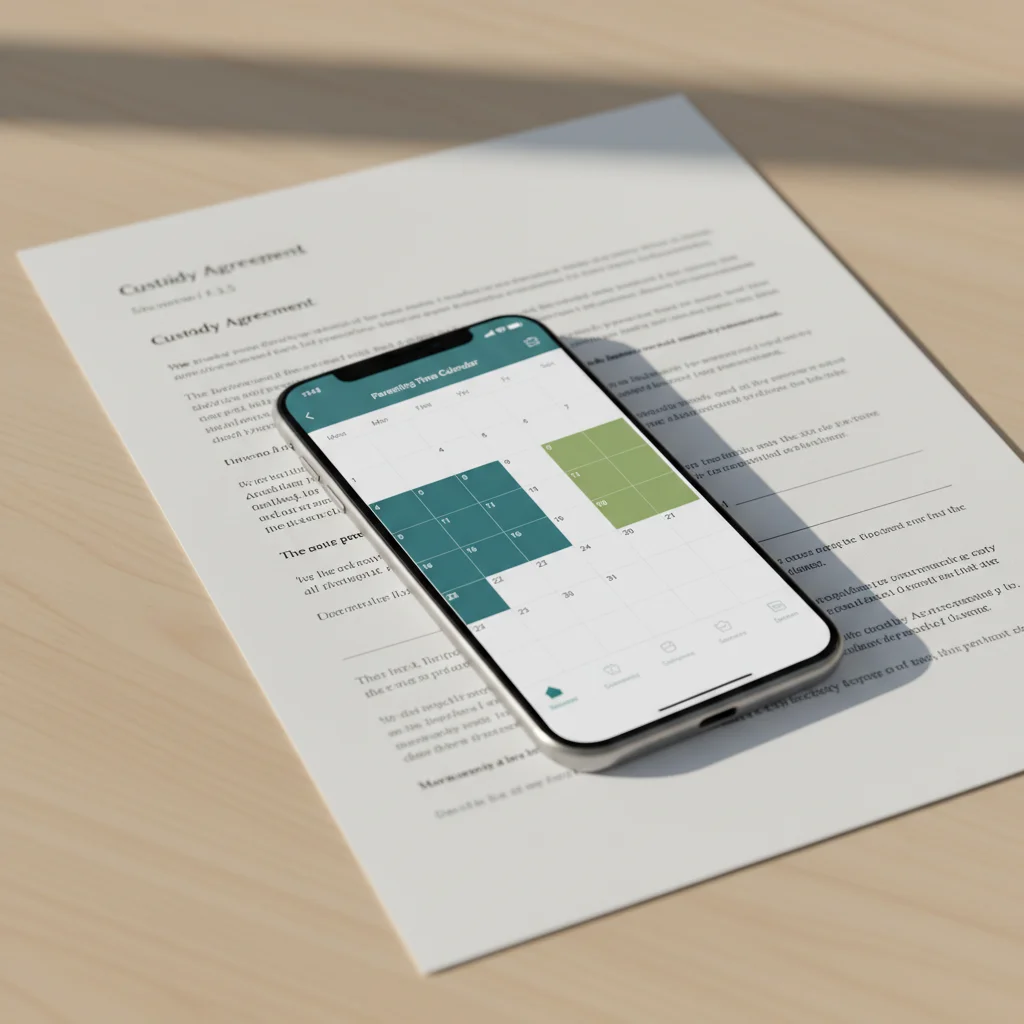
This is the gap Parenting Path was built to close. Our court order compliance feature takes your signed custody agreement and converts it into a working parenting time calendar — without retyping anything. The schedule, the holiday rules, the exchange times all populate automatically. From there, the shared calendar, the expense tracker, and the messaging layer enforce the agreement quietly in the background.
One subscription covers both parents. No per-parent pricing. See the full plan breakdown on the pricing page.
Turn your signed agreement into a working calendar
Parenting Path's court order parser reads your custody agreement and builds the calendar automatically — no retyping, both parents on one subscription.
Join the waitlistWhat to Do After You Sign
Once both parents sign, the document needs to be turned into a court order.
1. Notarize if your state requires it. Many states do, especially when one parent will not be present at filing. A notary at your bank or a UPS Store handles this for $5 to $25.
2. File with the family court. The court that has jurisdiction over your child — usually the county where the child has lived for the last six months. Pull the filing checklist from the court's self-help portal. Filing fees range from $50 to $400 depending on the state and your income. California parents, for example, can pull the full custody filing workflow from the California Courts Self-Help custody guide, and most other state court systems publish a similar resource.
3. Attend the parenting class if required. About half of US states require a parenting education class before the judge will sign an uncontested custody order. The class is typically 4 to 8 hours, online or in person, costs $25 to $75.
4. Wait for the judge's signature. In uncontested cases, this usually takes 30 to 90 days. Once the judge signs the order, the agreement becomes enforceable. The National Council of Juvenile and Family Court Judges' Enhanced Resource Guidelines describe the standards judges use when reviewing custody arrangements — worth a skim if you want to understand what the court is looking for.
5. Save the final order in three places. Original signed copy in a fire-safe location, scanned PDF in cloud storage, and a copy uploaded to your co-parenting platform of choice. If the agreement ever needs to be enforced, you want it accessible immediately.
If you ever need to refresh on what specific clauses mean in legal terms, our companion guide breaks down how to read your court order section by section.