

A custody court order is a legally binding document that defines each parent's custody time, decision-making authority, and obligations. Reading it means identifying the schedule, the legal vs. physical custody split, and any specific requirements — such as a court-ordered communication app — that both parents must follow.
Understanding your court order starts with a plain answer: a custody court order is a signed legal document that controls how you and your co-parent share time, expenses, decisions, and information about your children. Most parents have read parts of it. Very few have read the whole thing. Almost no one has a system to track whether both parents are following it.
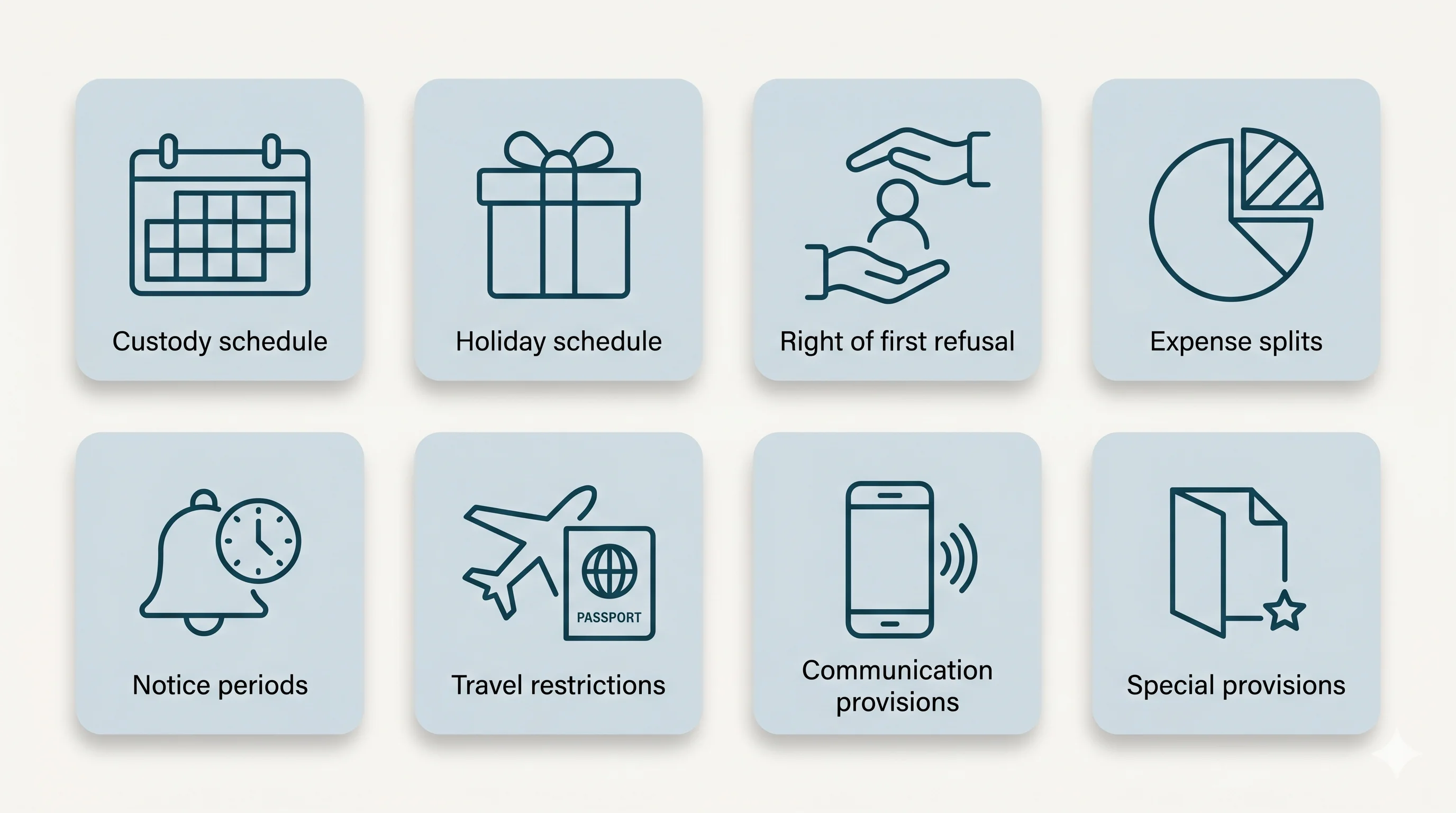
- Custody schedule — which parent has the child on which days.
- Holiday schedule — the holidays that override the regular schedule and how they alternate.
- Right of first refusal — whether the other parent must be offered care before a third party.
- Expense split ratios — how child-related costs are divided (rarely 50/50).
- Notice periods — how far in advance schedule changes and travel must be communicated.
- Travel restrictions — consent rules for out-of-state and international trips.
- Communication provisions — phone, video, and messaging rules during the other parent's time.
- Special provisions — tax claims, insurance, new partners, counseling, religion, education.
This guide is informational only. State laws vary, and individual court orders contain language specific to your case. Consult a qualified family-law attorney in your jurisdiction before acting on a contested clause. If you are in danger, the National Domestic Violence Hotline is available 24/7 at 1-800-799-7233.
Parenting plan vs. custody order
A parenting plan is the negotiated document that lays out custody, holiday rotation, decision-making authority, and dispute resolution. A custody order is that parenting plan once a judge signs it. After signature, every clause inside the plan becomes enforceable. In most states the two terms are used interchangeably once the order is entered, but only the signed version carries contempt risk for non-compliance.
If you have only the negotiated draft and not the signed version from the court clerk, request a certified copy from the family-court file before you rely on any clause as binding. State court self-help portals like the California Courts Self-Help Center and the Texas OAG custody and visitation portal publish jurisdiction-specific guidance on how to obtain a certified copy.
The eight clause types in most custody orders
Read your order in two passes. The first pass identifies the eight common clause types. The second pass converts each clause into a tracked rule so you can see what action is required on what date.
| Clause type | What it controls | Common pitfall |
|---|---|---|
| Custody schedule | Which parent has physical custody on which days | "Transition time" not defined, leading to pickup disputes |
| Holiday schedule | Holidays that override the regular schedule | Year alternation rule applied inconsistently |
| Right of first refusal | Offering care to the other parent first | Threshold hours and exclusions misread |
| Expense split ratios | How child-related costs are divided | Category-specific splits forced into 50/50 |
| Notice periods | Advance notice for travel and changes | Written-notice format ignored (text vs. portal) |
| Travel restrictions | Consent rules for out-of-state and international travel | Passport possession terms missed |
| Communication provisions | Phone, video, and message rules during the other parent's time | Blocked calls treated as harmless |
| Special provisions | Tax claims, insurance, new partners, counseling, religion | Annual provisions never re-read |
1. Custody schedule
The foundation of your order. This clause defines which parent has physical custody on which days. Common patterns include alternating weeks, the 2-2-3 rotation (Parent A Monday and Tuesday, Parent B Wednesday and Thursday, Parent A Friday through Sunday, then swap the following week), the 5-2-2-5 split, every-weekend arrangements, and birdnesting variants where the child stays in one home and the parents rotate.
Real-world example: An alternating-weeks order says "Parent A has physical custody from Friday at 6 p.m. through the following Friday at 6 p.m." If neither parent confirms the Friday transition window, missed pickups become routine. The most common pitfall on this clause is that "transition time" is implied rather than explicit, and a 30-minute delay becomes a documented dispute.
2. Holiday schedule
Holiday provisions override the regular custody schedule for specific dates. Thanksgiving, winter break, spring break, birthdays, Mother's Day, Father's Day, religious holidays, and summer vacation are the most commonly specified. These usually alternate by year — odd years with one parent, even years with the other.
Real-world example: "Thanksgiving from Wednesday at 6 p.m. to Sunday at 6 p.m. is with Parent A in odd-numbered years and Parent B in even-numbered years." The clause looks simple, but in practice families miss that "Thanksgiving" can run across what would otherwise be the other parent's regular week. The holiday clause silently consumes four days that the calendar would otherwise have assigned by rotation, and that is exactly where compliance disputes start.
3. Right of first refusal (ROFR)
If a parent cannot personally care for the child during their custody time, they must offer the other parent the opportunity before arranging third-party care. ROFR clauses typically specify a minimum absence threshold — commonly 4, 6, or 12 hours — and often exclude specific categories such as school hours, work, or named relatives.
Real-world example: Parent A has a wedding 5 hours away on their Saturday. With a 4-hour ROFR clause, Parent A must offer the time to Parent B in writing before booking a babysitter or asking a grandparent. Skipping the offer is a clause violation even if the third-party care was perfectly safe. Authoritative reference material on ROFR variants is published by the ABA Section of Family Law.
4. Expense split ratios
How child-related expenses are divided between parents. The split may be a flat ratio (60/40), proportional to income (often called the income-shares model), or category-specific (medical 70/30, education 50/50, extracurricular 60/40). Most co-parenting apps only support 50/50 splits, which does not match what most signed orders actually say.
Real-world example: "Medical expenses uncovered by insurance shall be divided 65/35 between Parent A and Parent B respectively. Extracurricular activities shall be split 50/50, with prior written consent required for any activity exceeding $200 per season." A blanket 50/50 ledger silently violates this clause every time a co-pay is split. Custom expense splits are the only way to honor the order as written.
5. Notice periods
Most orders require advance notice for travel, schedule changes, medical decisions, school enrollment, and relocations. A common provision: "The relocating parent shall provide at least 30 days written notice of any trip outside the state with the child, including dates, destination, lodging contact, and a return itinerary."
Real-world example: A 30-day notice clause requires the trip to be communicated in writing on day 30 at the latest, not "around a month ahead." A text message sent on day 28 with incomplete details fails the clause. Judges treat missed notice as contempt-eligible when the requesting parent can show a documented pattern. Cornell Law School's Legal Information Institute glossary on child custody is a useful starting point for terminology.
6. Travel restrictions
Limits on travel with the child — typically requiring written consent for out-of-state or international trips, specifying how far in advance notice is required, and often setting passport possession terms. Many orders address Hague Convention countries separately, with stricter consent and itinerary requirements.
Real-world example: International travel often requires both notarized consent and a clause about who holds the child's passport between trips. Skipping the notarization step can mean the airline turns the child away at the gate, even though the trip was previously "agreed to" by text.
7. Communication provisions
Rules about how parents communicate with the child — and with each other — during the other parent's custody time. Orders often specify phone or video call windows, age-appropriate frequency, and whether communication must flow through a parenting app rather than personal text or phone.
Real-world example: "Each parent shall have a 10-minute phone or video call with the child nightly at 7 p.m. during the other parent's custody time." A blocked or missed call is a clause violation regardless of intent. When the receiving parent's phone is "off" three nights running, that is the documented pattern that gets surfaced in a future hearing.
8. Special provisions
Anything specific to your family. Common entries include which parent carries health insurance, who claims the child for taxes in which year, restrictions on introducing new partners (the common "no overnight guest of the opposite sex for 6 months" language), requirements for family counseling or co-parenting classes, religious upbringing, and education decisions.
Real-world example: A tax-claim clause that alternates the dependent exemption between parents in odd and even years quietly becomes a problem if neither parent re-reads the order in March. Both file with the same dependent, the IRS rejects one return, and the order itself is now evidence in a contempt motion. Special provisions are where families lose track most often because the clauses only matter once a year.
From court order to calendar: how a parenting plan parser works

The reason most orders go untracked is that a PDF is not a calendar. Reading the order once does not put a recurring rule anywhere. A court order parser closes that gap. The workflow has three steps:
- Upload the signed PDF. The parser extracts the eight clause types — custody schedule, holiday rotation, ROFR thresholds, expense splits, notice periods, travel rules, communication windows, and special provisions — into a structured list.
- Review the extracted clauses. Every clause is shown alongside the original PDF text so both parents can confirm the parser read each provision correctly before any rule is activated.
- Approve and activate monitoring. Once approved, the rule engine maps each clause to the shared calendar, fires alerts ahead of every notice deadline, and creates a permanent record automatically when a deadline passes without the required action.
This is what people mean when they say "parenting plan to calendar" — converting a static document into a set of monitored rules that watch the schedule every day. The legal text does not change. What changes is whether anyone notices a violation in time to act on it.
Parenting Path automates this. Upload the signed PDF and we extract every enforceable clause for your review.
See how it works →Why tracking compliance matters

A court order means nothing if nobody tracks whether both parents follow it. In practice, most violations go undocumented because parents either do not notice them or do not have a system to record them at the moment they happen.
When a pattern of violations is eventually raised in court, the parent making the claim often has no documented evidence — only a general assertion that "they never follow the order." Judges need specifics: which clause, what the required action was, what actually happened, and when. A reviewable written log of court order compliance is the difference between a contempt motion that succeeds and one that wastes a filing fee.
What to do if your co-parent is not following the order
- Document every instance. Date, time, which clause was violated, what was supposed to happen, and what actually happened. Vague entries like "missed pickup again" lose in front of a judge.
- Communicate in writing. Use your co-parenting app, not text messages. The record should be timestamped and permanently stored so it survives a phone replacement or carrier change.
- Consult your attorney. A pattern of documented violations is much stronger than a single incident. Your attorney can advise whether to file a motion for contempt, a modification request, or a status conference depending on jurisdiction.
- Use court-ready reports. If your app generates court reports, your attorney can review the full compliance record in minutes rather than spending hours compiling screenshots and emails manually.
Frequently asked questions
Not legal advice. This article is informational and does not constitute legal advice or create an attorney-client relationship. State laws vary, and individual court orders contain language specific to your case. Consult a qualified family-law attorney in your jurisdiction before acting on any clause discussed here. If you are in danger, the National Domestic Violence Hotline is available 24/7 at 1-800-799-7233.
Upload your court order. We'll do the rest.
Parenting Path extracts every enforceable clause, presents them for your review, and watches your calendar every day. Launching on iOS and Android soon — be first in line.
Join the waitlist