
AI message filtering scans a co-parenting message before it is sent, scores its tone, and flags hostile or inflammatory language so the sender can revise it. Parenting Path’s filter offers a calmer rewrite and a brief cooling period, reducing conflict while keeping every message on a permanent, timestamped record.
Every co-parenting app records what you send. Only one holds back the messages you would regret sending.
Parenting Path’s AI Message Filtering analyzes every outgoing message in real time, scores it across four dimensions, and — when tone thresholds are crossed — holds the message before it reaches your co-parent. This is not keyword flagging. It is a full language model that reads context, tone, and legal risk together. AI message filtering for co-parenting is, in short, an attempt to close the one gap that documentation-only apps leave wide open: the gap between what you typed at 11pm and what ends up on the record.
Research on high-conflict divorce has been consistent for three decades. Contempt, defensiveness, stonewalling, and personal attacks in written communication predict worse co-parenting outcomes and worse outcomes for children — a pattern documented across decades of research by John Gottman and replicated in court-adjacent samples. The Association of Family and Conciliation Courts (AFCC) publishes practitioner guidelines that draw heavily on this body of work. AI tone scoring is one applied response to it.
The four dimensions of tone scoring
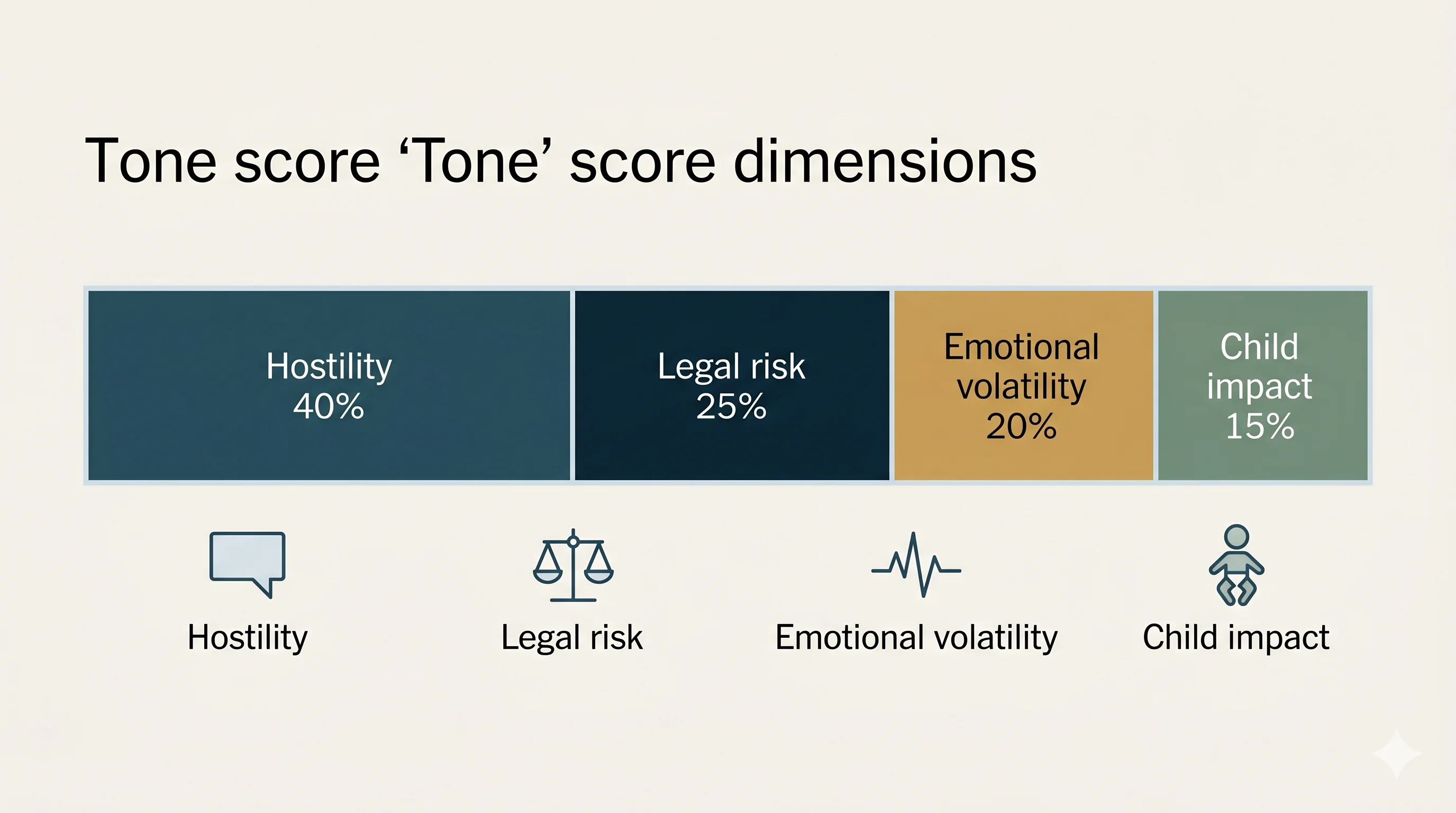
Every outgoing message is scored 0–100 across four weighted dimensions:
| Dimension | Weight | What it measures |
|---|---|---|
| Hostility | 40% | Aggressive language, threats, accusations, contempt |
| Legal Risk | 25% | Language that could harm your legal position in court |
| Emotional Volatility | 20% | Reactive, impulsive, emotionally charged language |
| Child Impact | 15% | Language that puts the child in the middle or is disparaging |
The composite score determines what happens next:
- 0–30 (Green): Message sends immediately. No interruption.
- 31–65 (Amber): Warning shown. You can send, view three AI rewrites, or delay delivery.
- 66–84 (Red): Strong warning. You must acknowledge the legal risk or choose a rewrite.
- 85–100 (Blocked): Message cannot send as written. You must use one of the three AI rewrites.
How the model actually works
This is the part most product pages skip. The scoring is not a keyword list. It is a sentiment-aware language model fine-tuned on family-law communication patterns, evaluating each draft message across several signal types at once:
- Sentiment polarity and intensity. Standard NLP, but tuned for written family-law context rather than product reviews. “Disappointed” reads differently in a custody thread than in a hotel review.
- Contempt markers. Sarcasm, name-calling, sweeping generalisations (“you always,” “you never”), and dismissive framing — the four-horsemen patterns from Gottman’s research that correlate with the worst long-term outcomes.
- Second-person framing and modality. Heavy “you” framing combined with command-mode verbs (“must,” “need to,” “better”) often signals an accusation or ultimatum, not a request.
- Deixis and child-reference handling. When a child’s name appears in the same sentence as a complaint about the co-parent, child-impact weight increases. The model is trained to recognise when the child is being used as a messenger.
- Legal-risk language. Phrases like “I’ll see you in court,” “you’ll never see them again,” or admissions about violating the order trigger the legal-risk dimension regardless of overall hostility.
- Thread context. The same sentence reads differently depending on what was said before it. The model looks at the most recent turns in the conversation, not only the message in isolation.
Privacy matters here, and it should be the first thing you ask of any AI feature in a co-parenting app. Message content is processed through a transient inference pass at the moment of send. It is not used to train the model, not shared with your co-parent, and not retrievable by Parenting Path staff in plain form. Tone scores and your edit decisions are stored as part of your permanent record, but the analysis pipeline itself is automated end-to-end.
The rewrite engine
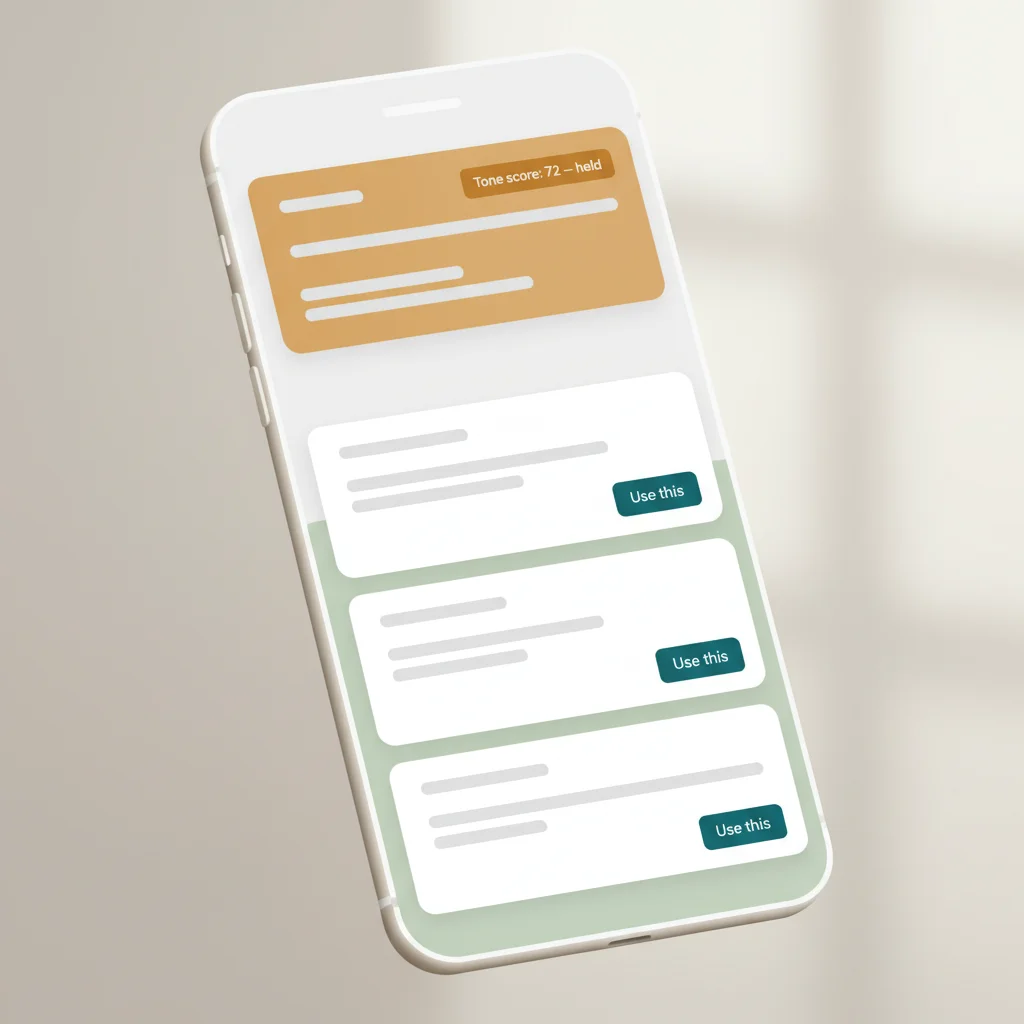
When a message is held, the AI generates three alternative versions in roughly a second or two. Each rewrite preserves your factual content — the dates, the requests, the logistics — while removing the emotional language and reframing around the child’s needs. None of the three is identical; you get a softer version, a more neutral version, and a version with the legal-risk language stripped out specifically.
You choose one, edit it if you want, and send. The permanent record shows the original message you drafted, the tone score, the rewrites that were offered, and the version you actually sent.
The cooling period
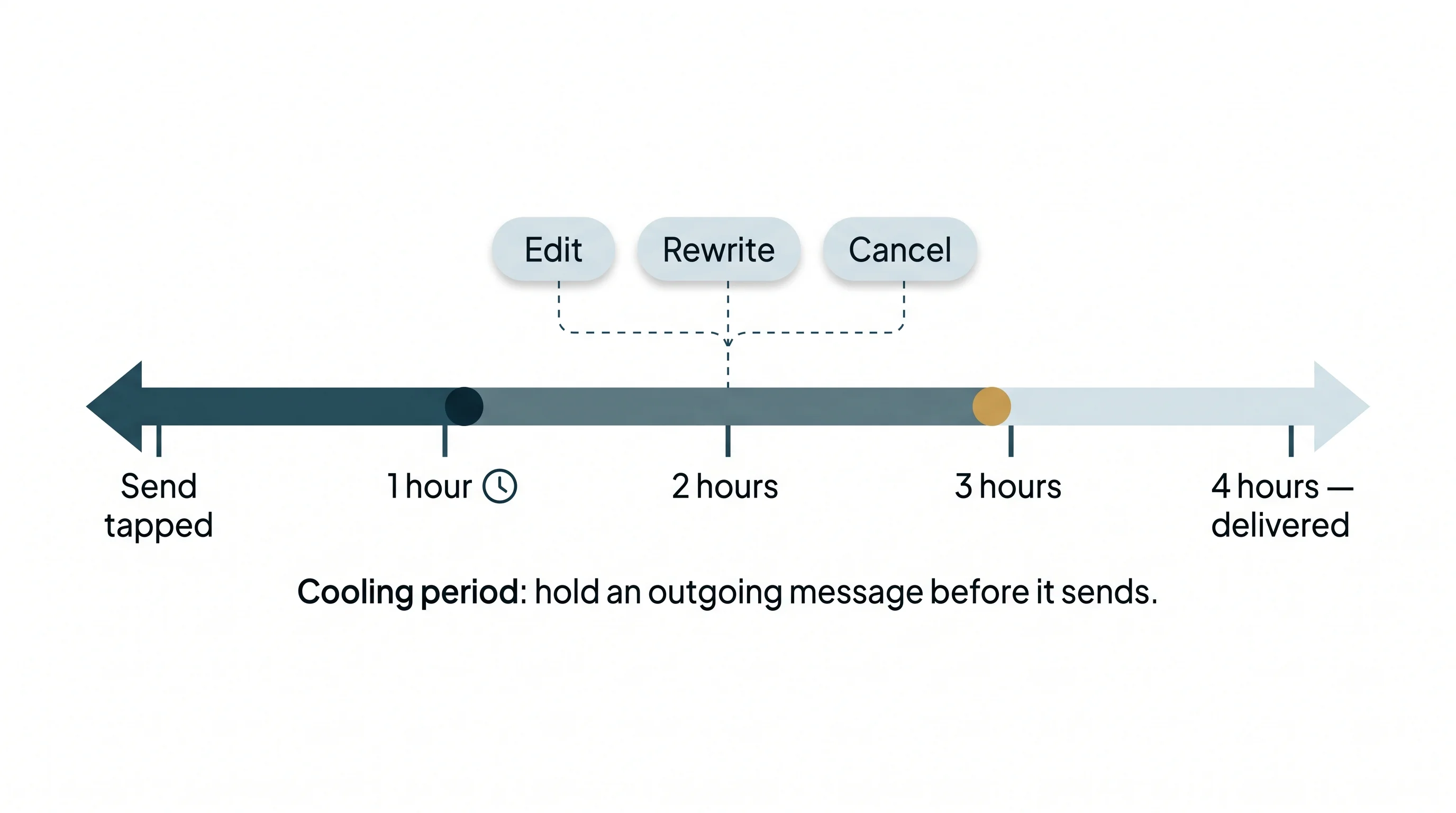
For amber and red messages, you can delay delivery by 1–4 hours. The message stays in your outbox. You can edit it, replace it with a rewrite, or cancel it before it sends.
The short delay matters more than the specific number of hours. Family-law mediators have long advised — including in AFCC practitioner materials — that the most damaging co-parenting messages tend to be sent inside the first few minutes of an emotional spike. A two-hour pause is usually enough to break that loop. Many parents who turn the cooling period on report choosing a rewrite or cancelling the message outright rather than sending the original draft.
Going through a high-conflict case? See how AI filtering, court order compliance, and 90-second court reports fit together for high-conflict families.
For high-conflict families →Incoming message protection
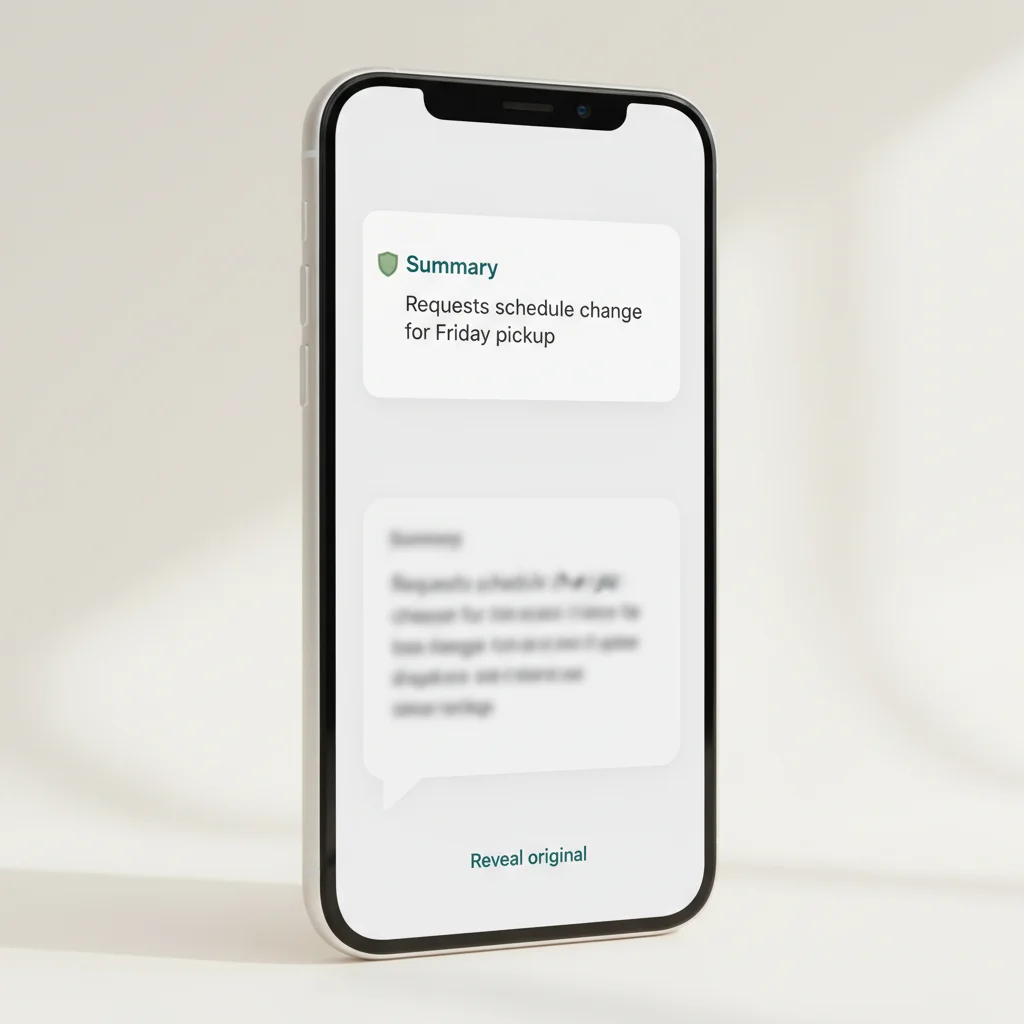
The same model protects what arrives. On the Pro plan, the Incoming Shield blurs hostile messages before you read them. You see a filtered summary of the facts — for example, “Requests schedule change for Friday pickup” — without the emotional attacks that surrounded the request. You can reveal the original when you are ready, or choose never to and reply only to the summary.
This is the half of conflict reduction that most co-parenting apps ignore entirely. The damage from a hostile message is not only what it makes the recipient send back; it is the emotional state it leaves them in for the next several hours.
Accuracy and limits
AI tone scoring is a decision-support tool, not a guarantee. It can miss sarcasm, cultural context, coded language, or threats expressed indirectly. It is not a substitute for legal advice from a licensed family-law attorney, and it does not replace clinical judgment about safety. If you are evaluating whether AI filtering fits your case, the American Academy of Matrimonial Lawyers is a good starting directory for attorneys familiar with high-conflict communication and technology-assisted co-parenting.
A few specific limits worth naming directly:
- English-language only at launch. Scoring quality drops on mixed-language messages and on languages other than English. We are working on this.
- Not a safety detection system. AI tone filtering can reduce friction in cooperative and high-conflict communication. It is not designed to detect coercive control, stalking, or threats of physical harm. For those, the dedicated DV Safety Mode features are the right tool — and they are free on every plan.
- Score is private to you. Your co-parent does not see your tone score, your draft, or the rewrites you considered. They see only the message you ultimately sent, plus the standard audit-log entry showing that the message was processed through Parenting Path.
- It learns conservatively. The model is tuned to err on the side of holding marginal messages rather than letting them through. That means some neutral messages will get an amber warning. You can always send anyway after reviewing the score.
If you are in a domestic-violence situation, the National Domestic Violence Hotline is available 24/7 at 1-800-799-7233 or thehotline.org. Please use those resources first.
Why this matters for your permanent record
Every co-parenting message you send through the app becomes part of your permanent record. If your case goes to court, your attorney — and likely your co-parent’s — will review every message in that record. A single hostile message can undermine months of cooperative communication.
AI filtering is not about controlling what you say. It is about making sure that what enters the permanent record reflects your best judgment, not your worst moment.
This is the gap most documentation-only co-parenting apps leave wide open. Tools like TalkingParents lock the record but do nothing to shape what goes into it — see the full Parenting Path vs TalkingParents comparison for how each platform handles tone, pricing, and account deletion. For a broader read on how the major platforms compare on filtering, court-readiness, and pricing, see our 2026 best co-parenting apps comparison.
Every decision is logged permanently. The original text, the tone score, whether you rewrote it, which rewrite you chose, and whether you used the cooling period — all of it is recorded in an integrity-verified audit log that feeds directly into your court reports.
Who has access to AI filtering?
AI Message Filtering is a Pro plan feature. On the Free and Standard plans, messages send without tone analysis. The permanent record and timestamping are available on all plans. See plan details.
Frequently asked questions
Is AI message filtering accurate?
AI tone scoring is a decision-support tool, not a guarantee. It evaluates hostility, legal risk, emotional volatility, and child impact with high reliability on English-language co-parenting messages, but it can miss sarcasm, cultural context, or coded language. Treat the score as a second opinion before sending, not as a substitute for legal advice from your attorney.
Does AI message filtering read my private messages?
Messages are analyzed for tone scoring only at the moment of send. The content is processed through a transient model inference and is never used to train the AI, never shared with your co-parent, and never visible to Parenting Path staff in plain form. Tone scores and your edit decisions are stored as part of your permanent record, but the analysis pipeline is automated end-to-end.
Can my co-parent see my tone score?
No. Your tone score is private to you. Your co-parent sees the message you ultimately send, the timestamp, and the audit-log entry showing the message was processed through the platform. They do not see the original draft, the score, the suggested rewrites, or whether you used a cooling period.
Does AI filtering work for domestic-violence situations?
AI tone filtering is not a safety tool. It can reduce friction in cooperative or high-conflict communication, but it is not designed to detect coercive control, stalking, or threats of physical harm. If you are in a domestic-violence situation, use Parenting Path’s DV Safety Mode features (free on every plan) and contact the National Domestic Violence Hotline at 1-800-799-7233 for crisis support.
Start free. Safety features included on every plan.
Parenting Path is launching on iOS and Android. Be first in line.
Join the waitlist